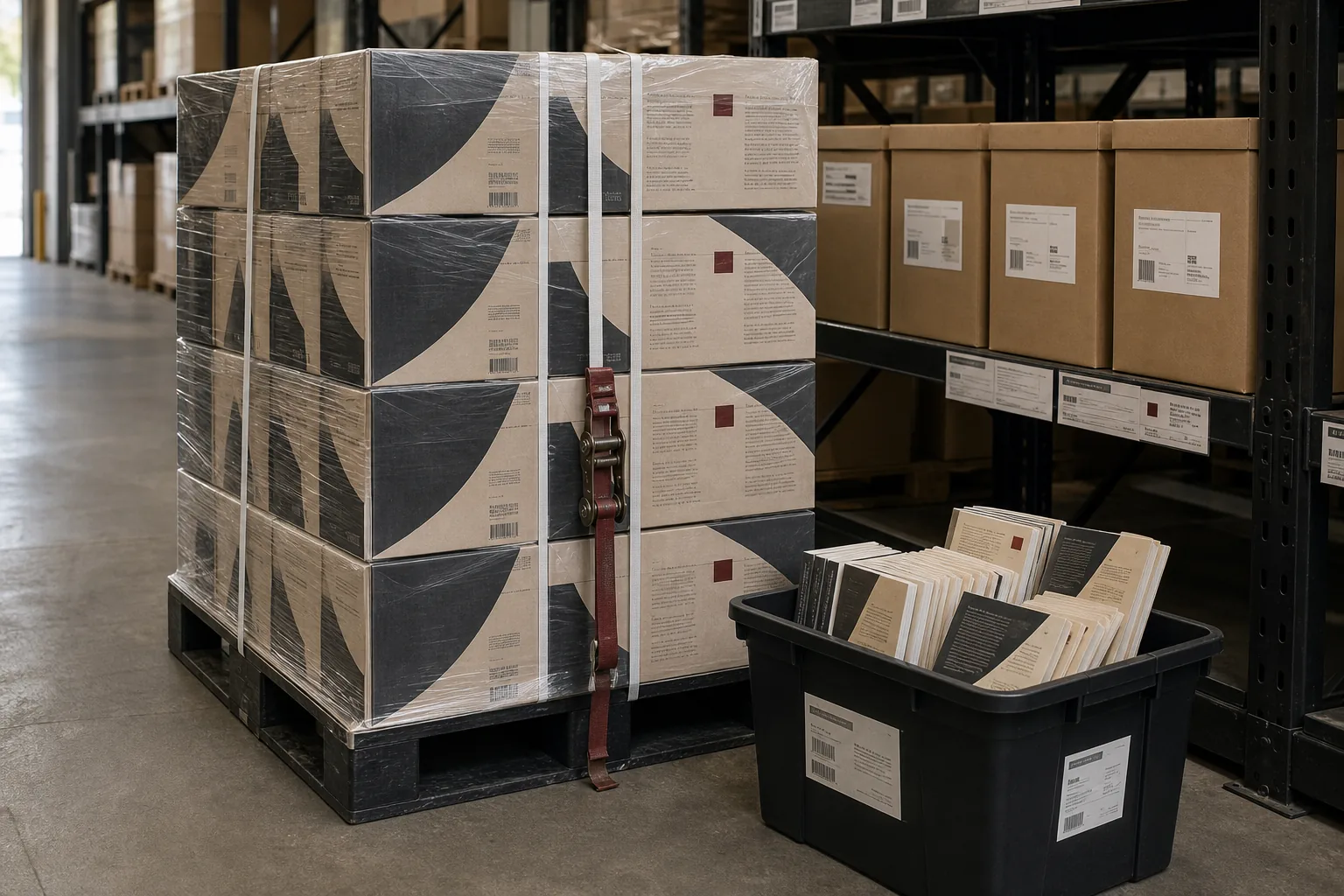
Publishing has a persistent little ceremony.
Somebody hears that your book has a large first printing and starts speaking of it as though the loaf had already won a prize.
It has not.
It is still dough.
A large print run says your publisher expects enough people to arrive at roughly the same breakfast hour to justify heating the big oven.
It may be an excellent expectation.
It may rest on preorders, comparable-title history, marketing commitment, and a channel with a date attached.
But it’s an expectation made months before anybody knows what readers will actually take home.
A large batch is a bet on a queue, not a verdict on the recipe.
Which matters because the same book can require two entirely different bakery decisions.
A club selection or a preorder surge can give you a morning queue substantial enough for offset: plates, setup, a run, freight, a warehouse, and the possibility of a second batch.
A specialist backlist title with a steady trickle of orders can belong in print-on-demand, where the file sits quietly until one customer asks for one copy.
Neither route confers virtue.
Nobody has ever become a better novelist because a pallet existed.
So the useful question isn’t whether your title deserves a large run. That question has the vague moral majesty of a croissant in a beret.
Ask instead: is the demand a spike, or a long tail?
Then model the batch, the shelves, the return, the reprint, and the lean morning after the launch.
Inspect the queue before you warm the big oven
The diagnostic is brutally practical.
Is there a reason many copies will be wanted at once, before the dough goes in?
Or is your evidence a continuing but dispersed specialist demand?
Your first-printing number gets set from preorders, comparable sales history, and marketing commitment, months before genuine sell-through exists.
Which is why a very large run can be rationally planned and still look theatrical afterwards.
American Dirt went out with a five-hundred-thousand-copy first printing in January 2020. Behind it sat a seven-figure auction advance, a heavy campaign, and a club selection treated as a strong presale signal.
Its first week recorded roughly forty-nine thousand print copies through point-of-sale reporting.
The issue was never that readers rendered a verdict against the book with a tiny rubber stamp.
The morning queue assumed by the batch did not arrive in the expected shape.
The opposite error is no more flattering.
In 2000, Scholastic went back to press for a second three-million-copy printing of Harry Potter and the Goblet of Fire, in the tightest printing capacity the trade had seen, with industry reprints running more than a month behind schedule.
A book that sells past its batch leaves your readers at the door while the next batch queues for oven time behind everybody else’s.
So separate lay-down from sell-through.
Lay-down is the physical commitment made before release.
Sell-in is what your accounts receive.
Sell-through is the rate at which those shipped copies actually reach readers.
The first is a forecast.
The second can be an optimistic distribution event.
The third is the reading that decides whether another batch belongs in your oven.
Conflate them and you have mistaken a busy loading dock for breakfast.
Consider two histories of the same imagined novel. A complicated family story with a particularly good title and no obligation to behave like an allegory for bread.
In the first, a club selection is known before publication and accounts can plan around its window. You lay down an offset batch, because the demand is concentrated in time.
In the second, the launch passes quietly. Years later, specialists keep ordering a handful each month. You convert the surviving production file to print-on-demand.
Same recipe.
Different queue.
The distinction is timing.
Stress the batch against half the trays coming back
Now ask the uncomfortable question.
What if half of it returns?
That’s not an instruction to predict a universal return rate. It’s a stress test on the quantity already sitting in your warehouse.
The press invoice is only the first tray on the rack.
Offset manufacturing runs at roughly a dollar a paperback and twice that a hardcover, plus pennies a unit in domestic freight.
Those are real costs, and they are the ones you will be quoted.
They are also not the part that makes a bad batch linger in the bookseller’s dreams.
The more revealing figure is the ratio. One printing executive’s often-quoted account holds that for every $14 spent printing, publishers put another $96 into warehousing, administration, and pulping obsolete stock.
The flour is cheap.
Keeping yesterday’s unsold pastries in a temperature-controlled annex, moving them, counting them, and finally destroying them is where the bill learns to sing.
Which is why pulping is not evidence that the trade has been deranged by spreadsheets and powdered sugar.
A slow or returned copy incurs a recurring warehousing fee while earning you nothing.
Pulping converts that accumulating liability into a one-time write-off.
In mass-market, the logic is starker still. The trade strips the cover at the point of return and sends only that back as proof, because returning the whole book for storage and eventual disposal can cost more than the recovery is worth.
That return mechanism is not a judgement on your text.
It’s a very unattractive storage problem.
So run the weak-season model before you admire the strong morning.
If demand slows, what holds the copies?
What happens to returns?
What does disposal cost?
If the answer requires a warehouse to become a charitable retirement village for sandwiches, your batch is larger than the channel can honestly support.
The next batch reads the till
A reprint is not the first printing with better posture.
It’s a new decision, made against sell-through and remaining stock, weeks or months after the initial forecast.
The uncertainty has changed by then.
The question is no longer whether anyone will buy your book.
It is how long the observed momentum will hold.
And reprint cost runs in two directions at once, which is where most reprint arguments go wrong.
Typesetting, cover files, proofing, plates, and press preparation are prepress costs paid on the original printing. They are sunk before your reprint, so the reprint’s fully loaded unit cost can be lower.
But a smaller batch gives up some long-run offset efficiency.
Digital short-run printing has changed the low end considerably, and average reprint quantities have climbed as a result, because small frequent orders no longer have to justify plate-making.
So the correct comparison is not that reprints are cheaper.
It is sunk setup versus smaller-run press economics.
This is also the moment to name a stereotype.
A second printing gets treated as your publisher’s standing ovation.
It can be exactly that, the way a baker’s second tray can be a compliment.
It can equally be a response to real demand after a deliberately cautious first batch.
The decision records a read of the till.
It does not rank the recipe above the books that needed a different service pattern.
The little oven against the large one
Offset gets cheaper as your volume rises, because it spreads a fixed setup cost across more copies.
Print-on-demand has no equivalent batch setup to amortise, and no press-running discount. Each copy carries the same fixed-plus-per-page structure.
Trade guidance has put the crossover somewhere around a thousand units.
Treat that as a baker’s pencilled note, not a commandment engraved on a mixing bowl.
Your true crossover moves with page count, trim size, and colour.
Above it, healthy offset volume beats a flat per-copy cost.
Below it, plates and setup may not be spread across enough copies to win.
And the comparison belongs inside a full model: offset unit cost plus your expected warehouse, returns, markdown, and pulping exposure, against the higher flat unit cost and zero inventory risk of the alternative.
Which makes the reputation of print-on-demand as the sad little oven for books nobody wanted both rude and economically illiterate.
It is more expensive per copy than a healthy offset run.
It can be a poor choice for a genuinely fast-selling title, because the margin penalty continues on every copy above your crossover.
But it can be the rational route for sales too slow or uncertain to justify tying up cash in a batch that then has to occupy warehouse space.
That’s not failure.
It’s a different service model.
Take the midlist case you have all seen.
Four hundred copies of a second printing are still in the warehouse three years after publication, and sales have settled at fifteen or twenty copies a month.
You could order an offset reprint anyway, though usually only with a specific reason to expect a spike.
You could let the title go out of print entirely.
Or you could move the file to print-on-demand, and keep a book readers still want from becoming a ceremonial warehouse obligation.
The two histories meet exactly here.
Offset for the legible shock. The other oven for the tail that keeps arriving after the rush.
Can the file do the baking?
Print-on-demand is not a reprint in miniature.
It’s a one-time conversion of a print-ready file into a manufacturing state where nothing physical exists until an order arrives.
The same PDF you used for offset often works, or a lightly reflowed version does.
But it has to be checked against supported trim sizes, page-count and binding limits, a cover template, and colour eligibility.
Your straightforward black-and-white novel may pass without a substantive change.
Colour inserts, unusual trim, and specialty binding may not.
Once accepted, your file is dormant.
Your inventory line effectively goes to zero without the book going out of print.
Retail availability becomes a matter of metadata and price. A bookstore ordering through a wholesaler, a library buying through its supplier, or an online retailer can all see the title as orderable, because the network reports it, not because a warehouse contains a copy.
The shelves have become an order ticket.
When a customer orders, one copy releases to a press, is printed and bound, and usually reaches them within a few business days.
There’s no waiting for enough orders to make a batch.
There’s no conventional reorder point either. The fixed charge and the per-page rate apply identically to the first order of the week and the tenth.
Each ticket turns on the little oven.
The next one does the same.
And here is the operational gift.
No warehousing between batches, because there are no batches.
No remainder decision, because unsold stock cannot accumulate.
No pulping decision for the new copies, and no reprint-authorisation meeting needed to keep the title selling.
But don’t mistake technical availability for active market presence.
Some platforms work from a retail price and a wholesale discount rather than a fixed royalty split, and a discount too low to interest retailers leaves a technically orderable book that nobody actually stocks.
A bakery may take orders.
It doesn’t follow that every shop puts the cake in its window.
Split the shock from the tail
The ambiguous case is the book with both a morning queue and a later specialist clientele.
Your book receives an announced demand event, then settles into a long, useful afterlife.
Forcing one production system to carry both jobs is less sophisticated than it sounds.
So run the timed shock through offset, if preorders, comparable history, marketing, and an identifiable event justify a batch. Then watch sell-through against remaining stock.
If the surge proves durable, reprint on actual data.
If it fades to a thin but persistent line, convert the compatible file rather than asking a warehouse to host a permanent brunch.
Your title can move from offset stock to a dormant file without changing its text, its readers, or its category.
This also spares you a silly hierarchy.
Offset is not the grand oven and print-on-demand the toaster in a bedsit.
Each makes a different promise to the market.
Offset says the bakery is willing to have bread waiting for a real, concentrated queue.
The other says a reader need not find the title unavailable merely because the queue has become individual and irregular.
Both are channel decisions.
Both carry cost structures.
Neither tells anyone whether the book is good.
So a large print run is most informative when you read it narrowly.
It says: on this morning, through this route, with these costs and this expected queue, a publisher chose a big batch.
The reader’s actual verdict arrives later, copy by copy, in sell-through.
And when the batch gets bigger, the final question stays delightfully unromantic.
Is there a real morning queue outside the bakery?